Best Fanfic Writing AI: Which Tool Actually Understands Fandoms, Character Voice, and Long-Form Storytelling?
16.5.2026
Best Fanfic Writing AI: Which Tool Actually Understands Fandoms, Character Voice, and Long-Form Storytelling?
If you searched for the best fanfic writing AI, you are probably not looking for a generic chatbot that can spit out a random scene in ten seconds. You are looking for a tool that can actually handle fandom-specific writing: character voice, relationship dynamics, alternate universes, slow-burn pacing, canon divergence, and long-form continuity. If you already have a premise in mind, you can Open Fanfic Generator and start drafting paragraph by paragraph instead of forcing a general AI assistant to guess how your fic should unfold.
This guide is based on two things: first, a review of the current ranking pages targeting AI fanfic keywords; second, a close read of a recent Reddit discussion in r/WritingWithAI where users compared five popular AI engines specifically for fanfiction. That matters because “best” is not really about raw output speed. For fanfic writers, the best tool is the one that respects character voice, supports iterative drafting, and does not flatten everything into generic prose.

Best Fanfic Writing AI: What Matters More Than Raw Output
Most AI writing comparisons focus on broad categories like speed, pricing, or whether the tool can generate long responses. Fanfiction readers and writers usually care about a different set of problems:
- Does the character sound like the character?
- Does the emotional reaction make sense in context?
- Can the tool keep track of relationship tension across multiple scenes?
- Does it support fandom-specific setups instead of pushing everything into generic fantasy prose?
- Can you revise the story incrementally instead of replacing the whole draft every time?
That is also why many “best AI writer” roundups miss the point for fanfic. A tool can be excellent for essays, blog posts, or general fiction and still be frustrating for fandom writing. Fanfic is much more voice-sensitive. Readers already know the canon personalities, rhythms, and dynamics. If the AI loses those, the story stops feeling like fanfic and starts feeling like a generic imitation.
How We Evaluated the Best Fanfic Writing AI Tools
One of the most useful sources we reviewed was this Reddit thread: My personal rankings of 5 popular AI engines for writing fanfiction. The original poster compared Claude, Grok, ChatGPT, DeepSeek, and Gemini using seven practical criteria:
- general realism
- emotional realism
- humanity
- level of detail
- context window
- chat limits
- explicitness
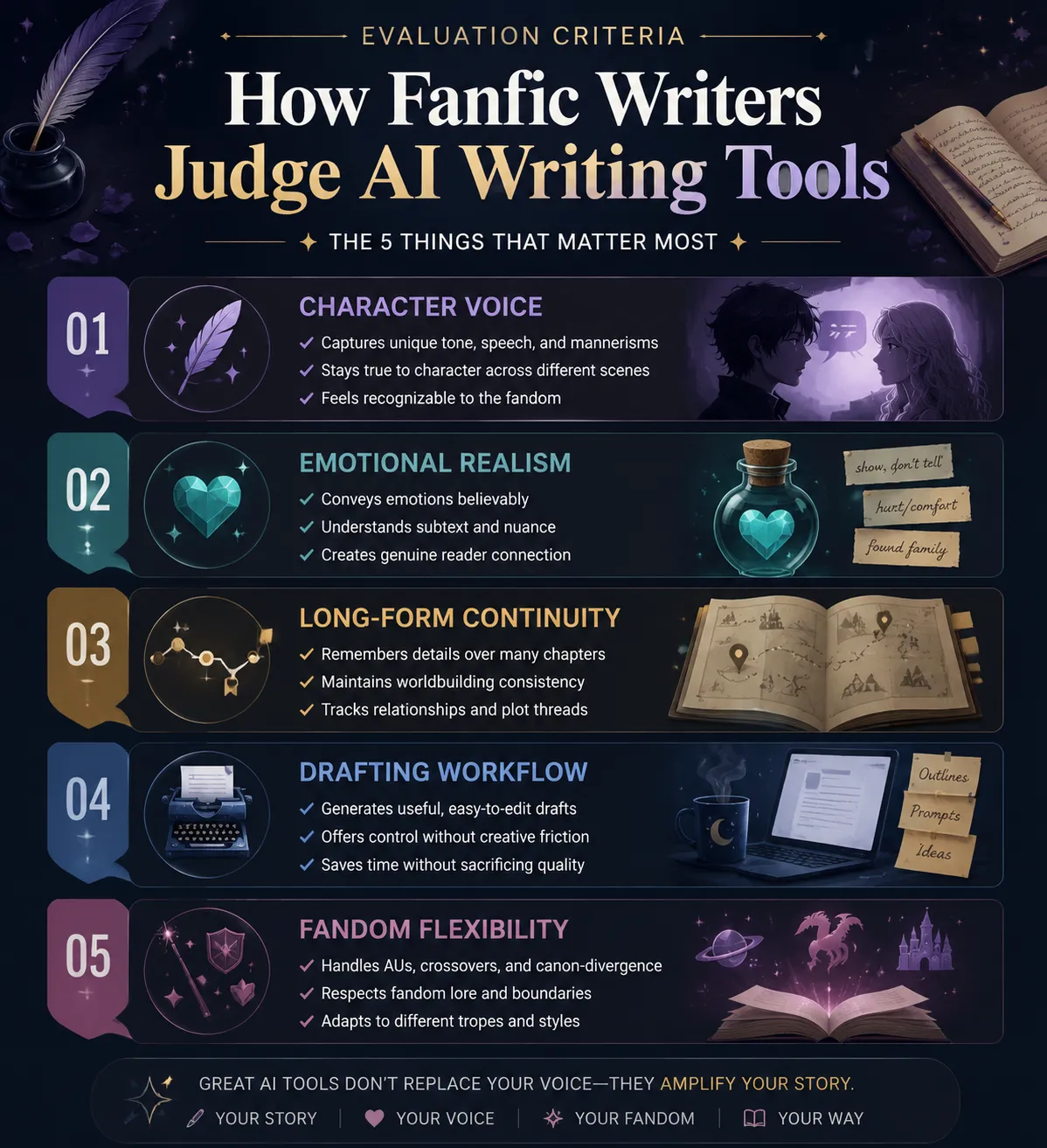
That framework is stronger than the average affiliate-style roundup because it reflects how fanfic is actually written and revised. For this article, we simplified the evaluation into five decision points that are easier for a reader to apply:
- Character voice: can the AI keep dialogue and reactions believable?
- Emotional realism: can it write tension, vulnerability, and payoff without feeling robotic?
- Long-form continuity: can it keep track of the setup across multiple paragraphs or chapters?
- Drafting workflow: can you work scene by scene, paragraph by paragraph, and revise without losing control?
- Fandom flexibility: does it handle AUs, ships, crossovers, and canon-divergent prompts naturally?
Those five criteria align much better with what Google should reward for this keyword as well: a real comparison with transparent standards, not a listicle that claims every product is “powerful” and “easy to use.”
Best Fanfic Writing AI Tools Compared by Real Fanfic Needs
After reviewing current ranking pages and the Reddit discussion, the market breaks down into four practical groups rather than one single winner.
Claude: Best for prose quality and emotional writing
The Reddit ranking placed Claude first overall, mainly because of its realism, emotional nuance, humanity, and detail level. That result makes sense. Claude is usually strongest when you want cleaner prose, better scene flow, and emotional reactions that feel closer to human-written fiction.
For fanfic writers, Claude is especially useful when:
- you want stronger scene-level prose
- you care about internal monologue and emotional transitions
- you are revising a draft rather than generating from zero
- you need help maintaining tone over a longer passage
The main downside is control and restriction. Writers in the Reddit thread repeatedly pointed out that Claude can be conservative with certain content, and free-tier message limits can slow down longer writing sessions.
Grok: Best for looser experimentation and fewer content restrictions
In the same Reddit thread, Grok ranked second overall. It scored well for humanity, emotional realism, and willingness to engage with more graphic or less sanitized content. That makes it appealing for writers who want freer experimentation or more chaotic creativity.
Where Grok tends to work well:
- edgy or high-drama scenarios
- fandoms where informal tone helps
- experimental scenes, alternate versions, or character chemistry tests
Where it can be weaker:
- output consistency from scene to scene
- dependable long-form structure
- controlled editing workflow
ChatGPT and DeepSeek: Useful, but often better as support tools than primary fanfic engines
The Reddit thread treated ChatGPT and DeepSeek as solid but not clearly dominant for fanfiction. That matches what many writers now report in practice: these models can be helpful, but often work better as support systems than as the main drafting environment.
They are good for:
- outlining
- story bible work
- continuity checks
- alternate plot branches
- rewriting a rough paragraph more cleanly
They are less dependable when you need:
- highly specific fandom voice
- emotionally layered scenes
- strong ship chemistry without flattening it
- sustained chapter-by-chapter continuity
Fanfic Generator: Best for practical fandom-first drafting
This is where a specialized workflow matters. General chatbots are often strongest when you already know how to steer them. But many fanfic writers do not want to prompt-engineer every paragraph from scratch. They want a faster way to move from fandom premise to workable draft.
That is where Open Fanfic Generator fits better than a generic assistant:
- it is built for fanfic inputs such as fandom, genre, main characters, relationships, setting, plot outline, tone, rating, and scene direction
- it supports paragraph-by-paragraph writing, which is much closer to how many fanfic writers actually iterate
- it lets you keep creative control instead of replacing the whole story every turn
- it is easier to use for “draft first, polish second” workflows
For many writers, that makes it more practical than asking a general chatbot to magically understand fandom structure with minimal setup.
Why Most “Best Fanfic Writing AI” Articles Still Miss the Real Problem
Current ranking pages usually fall into one of three traps.
They compare generic writing tools, not fandom workflows
Many competitor pages list tools that are technically capable of generating fiction, but are not designed around fanfic inputs. That means the reader still has to do all the translation work: convert ships, canon history, relationship arcs, and AU context into a prompt format the model can follow.
They overfocus on feature count
A tool can have memory, image generation, templates, and document export and still not be good at fanfiction. For this keyword, feature count is secondary. The real question is whether the output feels like it belongs inside a fandom.
They do not separate drafting from polishing
This is a major mistake. The best tool for writing a first fandom draft is not always the best tool for polishing prose. Many writers should not be choosing one universal AI. They should be choosing a workflow.
A Better Workflow for Fanfic Writers: Draft With Structure, Then Polish
If your goal is to finish more stories instead of endlessly testing prompts, the most practical workflow looks like this:
1. Start with a fandom-specific draft setup
Begin with:
- fandom or universe
- main characters
- relationship dynamic
- setting
- story direction
- tone
This is exactly the kind of structured setup that Open Fanfic Generator is designed to handle.
2. Write paragraph by paragraph instead of asking for a whole chapter
Whole-chapter generation often creates pacing problems. A paragraph-by-paragraph workflow gives you better control over:
- dialogue rhythm
- emotional escalation
- canon references
- ship progression
- scene transitions
3. Use another model only where it actually helps
If you want stronger prose polish, you can still bring a paragraph into another AI later. But that should be a targeted step, not your whole writing system.
4. Keep your fandom judgment at the center
No model truly “knows” your ship, headcanon, or emotional pacing the way you do. The tool should accelerate your process, not replace your judgment.

Why Fanfic Generator Is a Strong Choice if You Want the Best Fanfic Writing AI for Drafting
If we narrow the question from “best fanfic writing AI overall” to “best fanfic writing AI for actually getting a draft moving,” Fanfic Generator has a clearer advantage than many broad-purpose tools.
Here is why:
- it starts from fanfic-specific fields instead of generic open-ended chat
- it is easier to shape scene by scene
- it is better aligned with writers who post on AO3, Wattpad, or fandom-specific communities after revising
- it reduces the friction between idea and first draft
That makes it especially useful for:
- readers becoming first-time writers
- writers stuck in the outline phase
- fandom creators testing multiple scene directions
- ship-focused writers who need emotional control more than “perfect” one-shot prose
If that sounds like your workflow, Start Writing and build the story incrementally instead of waiting for a general chatbot to produce the exact scene in one shot.
FAQ: Best Fanfic Writing AI
What is the best fanfic writing AI for long stories?
For long stories, writers usually need both continuity and control. General-purpose tools can help, but a structured drafting workflow is often more reliable than one giant prompt. That is why paragraph-by-paragraph tools can be more practical for multi-chapter fanfic.
What is the best fanfic writing AI for character voice?
Based on the Reddit comparison we reviewed, Claude scored strongest for human-sounding prose and emotional realism. But character voice still depends heavily on your setup and revision process.
Is there one best fanfic writing AI for everyone?
No. Some writers need prose polish, some need fewer restrictions, and some need a better drafting workflow. The better question is: what part of fanfic writing are you trying to improve?
Is Fanfic Generator better than a general chatbot?
For fandom-first drafting, often yes. A specialized fanfic workflow can be more efficient than forcing a general chatbot to reconstruct the fandom context from scratch every time.
Final Verdict: The Best Fanfic Writing AI Depends on How You Actually Write
If you want the strongest prose polish, Claude is still one of the most convincing options in current community discussions. If you want looser experimentation, Grok may feel less constrained. If you mainly need outlining and support work, ChatGPT or DeepSeek can still be useful.
But if your real goal is to move from fandom premise to usable draft with less friction, Fanfic Generator is the more practical choice. It is built around the way fanfic ideas are actually formed: fandom, characters, relationships, tone, setting, and what happens next.
That is why the best answer to this keyword is not just “pick the smartest model.” It is: pick the workflow that helps you finish fanfiction. If you already have a ship, AU, or chapter idea in mind, Open Fanfic Generator and start drafting the story the way fanfic writers actually work.